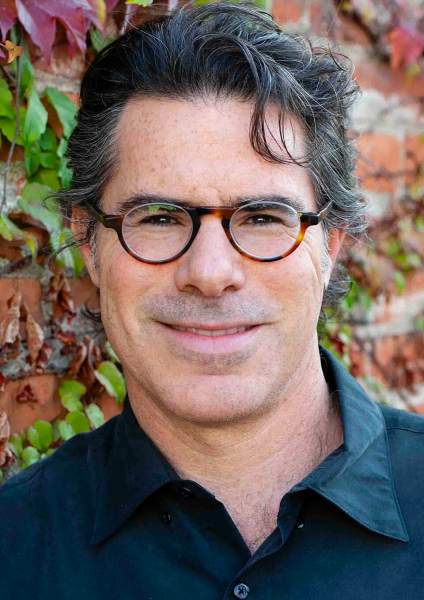
At the US Northwest Coast, 2025, by Ravi Sadu
At the US Northwest Coast, 2025, by Ravi Sadu
Who is Yoav Litvin?
I was born on August 31st, 1976, in Jerusalem, Israel, the youngest of three children, to a family of Ashkenazi Jews. My mother Ilana and father Yair were both born in Israel. My maternal grandparents, Judith and Marcus Bezner, were German and Polish Jews, respectively, who fled Nazi persecution in the 1930s, while my paternal grandparents, Tova and Volodya Litvin, were Russian Jews who immigrated to Palestine in the early 20th century.
I wear many hats. Trained as a behavioral neuroscientist, I see myself as an artist, a photographer, an analyst, a musician. I love learning new things and making many mistakes along the way.
What were your early years like?
I grew up in Jerusalem, playing in its beautiful hills. In 1982, at age 6 my family moved to the United States — to New York City. It was a difficult transition for me, learning a new language, making new friends, and dealing with a home life that was often unstable and conflictual. As a child it was difficult to adjust to the new environment of the United States. we lived in faculty housing in the Bronx, and New York City had many issues during that period with respect to safety, crime and poverty. However, after several years I integrated well into American society, was an avid baseball and tennis fan and spoke English better than Hebrew. That’s when my family decided to move back to Israel, and I went through the trauma of moving yet again. Though I was happy to be by my beloved grandparents again.
And who were your grandparents?
I spent a lot of time with my maternal grandparents, who were icons in Jerusalem. They owned the biggest shoe store in town - 'Comfort' - and knew everyone. My grandfather had been a professional soccer player and ballroom dancer in Vienna, Austria, before escaping the Nazis to Palestine. He arrived on an illegal ship after surviving for weeks on a bag of candy with nothing but the clothes on his back. My grandmother was a smart, powerful, beautiful woman who worked in the family business, which also included two of her younger brothers. I loved her deeply: whenever I came over from school, I'd stop at the florist and bring her flowers. My grandfather was an extraordinarily generous man who spoiled me with chocolates and cash every time I'd see him. Their love for their grandchildren was unconditional.
My paternal grandparents lived in San Francisco and therefore I met them only a handful of times at family events and never had an opportunity to develop any kind of meaningful relationship with them.
What was your school path?
I attended elementary school in New York City (grades 1—6) while my father completed a medical internship in endocrinology at the Albert Einstein College of Medicine in the Bronx, and my mother participated in an accredited psychology internship program at the same college. We then returned to Israel, where I completed junior high and high school in Jerusalem. They were considered good schools, but I never enjoyed the experience, except for the study of biology. I wasn't particularly popular or unpopular; I always had a few close friends, just not many.
As you went to primary school both in Israel and in the US, how would they compare?
The Israeli school was more secular than the Jewish school I attended in the US. It emphasized Israel and Zionism rather than Judaism. Otherwise, academically they were broadly comparable. The American school was seeped in the New York Jewish vibe and experience. The schools in Jerusalem were public schools that included kids from all over Jerusalem, and my high school also had a boarding school with students from all over the country.
What did you do after high school?
In 1994, at the age of 18, I was drafted into the Israel Defense Forces (IDF), where I served until 1997 as a medic in the paratroopers. I hated it and couldn't wait for it to end, though I did make some good friends. Today I wish I'd had the wits to refuse service, but I was immature and beholden to the dominant Israeli narrative about the supposed importance of military service. The army is truly one of the central organizing structures of Israeli society.
And after the army service?
I took a few years off to travel and work — in the restaurant business, as a bartender and server. In Jaipur, India, I met a Rajasthani Muslim family of traditional musicians and began studying tabla, the Indian percussion instrument, with the father, Rafiq Mohammad Hussain. His sons Rahis, Amrat, Tipu, and Sanjay were all budding musicians. I studied with Rafiq for years, returning to Jaipur every year and spending months there. When I first met them, they were living in poverty and unknown beyond their community. In the early 2000s, Rahis made it to Corsica and formed a group ''Dhoad Gypsies of Rajasthan''. They are now world-famous, having performed thousands of concerts around the globe, including for the Queen of England and Mick Jagger.
See here: https://yoavlitvin.com/dhoad-gypsies-of-rajasthan-nomads-in-times-of-xenophobia-and-mass-migration/
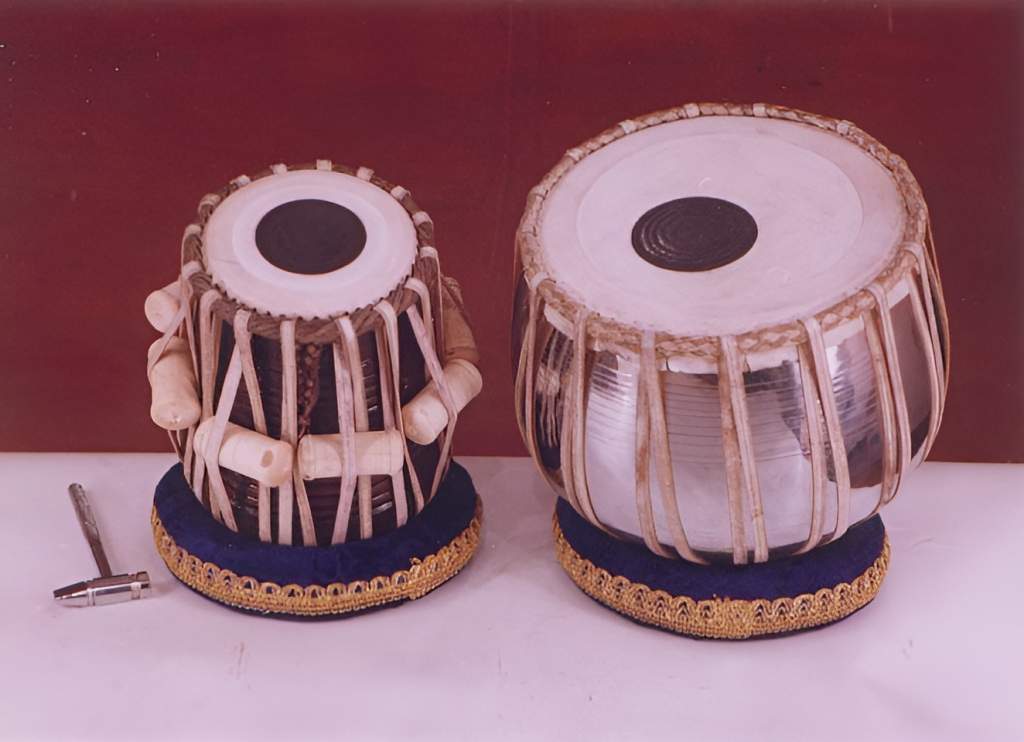
Tabla, 2005, photo by Pakrashi (Wikimedia Commons)
What was your diploma thesis in Biology and what in the Far Eastern Studies?
I began to study at the Tel Aviv University in 2000 and graduated in 2004 with a BSc degree in biology, with a minor in Far Eastern Studies; it was mainly history, philosophy and languages of the far east, including Indian, Chinese and Japanese culture. My bachelor's thesis in biology examined wild vole behavior: their behavioral repertoire, including defensive and offensive responses and other social behaviors. Near the end of my studies, I met Robert and Caroline Blanchard, pioneers in Behavioral Neuroscience and particularly in the study of emotion. They ignited an interest in animal and human behavior that animates my work to this day.
We did not write a thesis. I wrote an article for my work with voles with the Blanchards and Professor Eilam, yet it was never published. I received my degree based on an internal report I drafted about the work.
How did you get in touch with Robert and Caroline Blanchard?
They were friends with Professor David Eilam, director of the research zoo at the Tel Aviv University, where I volunteered in 2004. When he mentioned they were coming and asked if I'd like to work with them, I agreed immediately, especially once I heard they were from the University of Hawaii. I knew it was an opportunity, and I seized it. They invited my to work in their laboratory and in December 2004 I moved to Hawaii. Bob and Caroline were both brilliant and gracious, and their passion for behavioral neuroscience captivated me.
How was life in Honolulu compared to Tel Aviv?
Fantastic. I connected immediately with the Aloha spirit and was overjoyed to be out of Israel and its constant fearmongering and machoism. There I became friends with a man named George Hudes, with whom I hiked regularly and who profoundly shaped my worldview — about life in general, and about the reality in Israel/Palestine in particular. A veteran of the anti-Vietnam movement and active in the pro-Palestine movement, George wisely navigated my instinctual aversion to politics and my Zionist conditioning, and opened my eyes to a more humanistic perspective.
Working with mice in the laboratory is not for everybody. What were the challenges?
It is difficult to accept that animals must suffer for human 'progress,' which often amounts to little more than curiosity. So many things we take for granted are the result of animal research. But as my disillusionment with academia deepened and my politics developed, my curiosity ran out and my disgust with aspects of my work were brought to the fore. I simply didn't want to be part of it anymore.
How did it happen that you moved to New York?
After graduate school, which I completed with a PhD thesis Maternal separation modulates short-term behavioral and physiological indices of the stress response in 2008 under their supervision, I was looking for a postdoctoral fellowship. Professor Donald Pfaff's lab at The Rockefeller University was at the top of my list. Among many other discoveries and achievements, Don was the first person to elegantly map a complete brain circuit from brain to behavior, the female lordosis response in rats, and is a legend among behavioral researchers. The late Professor Bruce McEwen, widely regarded as the godfather of stress research, was also at Rockefeller. I knew Bruce's work from my collaboration with one of his students, Robert Sapolsky, who wrote the foreword to my book Wired to Steal. I ended up studying under both of them. In addition to being exceptional scientists, they were simply great people- brilliant, funny, honest, generous and humble. Perfect role models. I moved to NYC for postdoctoral studies after completing my PhD dissertation.
My postdoctoral studies in Neuroendocrinology and the Neurobiology of Stress at The Rockefeller University took place under the supervision of Professor Pfaff (2008-2011) and Professor McEwen (2011-2014).
The injury at squash turned your life upside down. How long were you hospitalized? And absent from work during the recovery?
The injury in February 2012 indeed changed my life. It was a disc herniation, not severe enough to require surgery or hospitalization — but it did take roughly a year to recover, and I never fully returned to where I was before. And it shook and injured my body but also my soul. I felt my mortality and decided I need a serious change in my life. That is when I discovered my passion for photography and street art/graffiti as a photography subject. I began walking everywhere, all over New York City and its boroughs. 15-20 miles a day. I may have been injured but I was not about to throw in the towel. Something new and exciting was motivating me and I started losing interest in my lab work.
How did you figure out that walking helps you recover the most?
Just before the injury, I visited Barcelona and discovered a new passion: photography of street art and graffiti. I was determined to explore the NYC scene and wasn't going to let the injury stop me. It turned out to be a perfect coincidence, maybe even fate. Walking relieved my pain better than any medication. It was as if life was forcing me to pursue this passion whether I was ready or not. It was also a factor in my leaving science and venturing into an independent career.
Photographing street art has also taken you to South America. What can you tell about that experience?
Early in 2015 I traveled through Colombia, Ecuador, Peru, Bolivia, Chile, and Brazil. My social media presence in the street art world allowed me to connect with artists in each of those places. I loved walking through those cities, discovering new work and getting to know local communities, the issues troubling them, the things inspiring them and everything in between. I just loved the ability of the arts to connect people and communities. It seemed to me to be the absolute opposite of the Western culture of war and fear that was such a fundamental part of me.
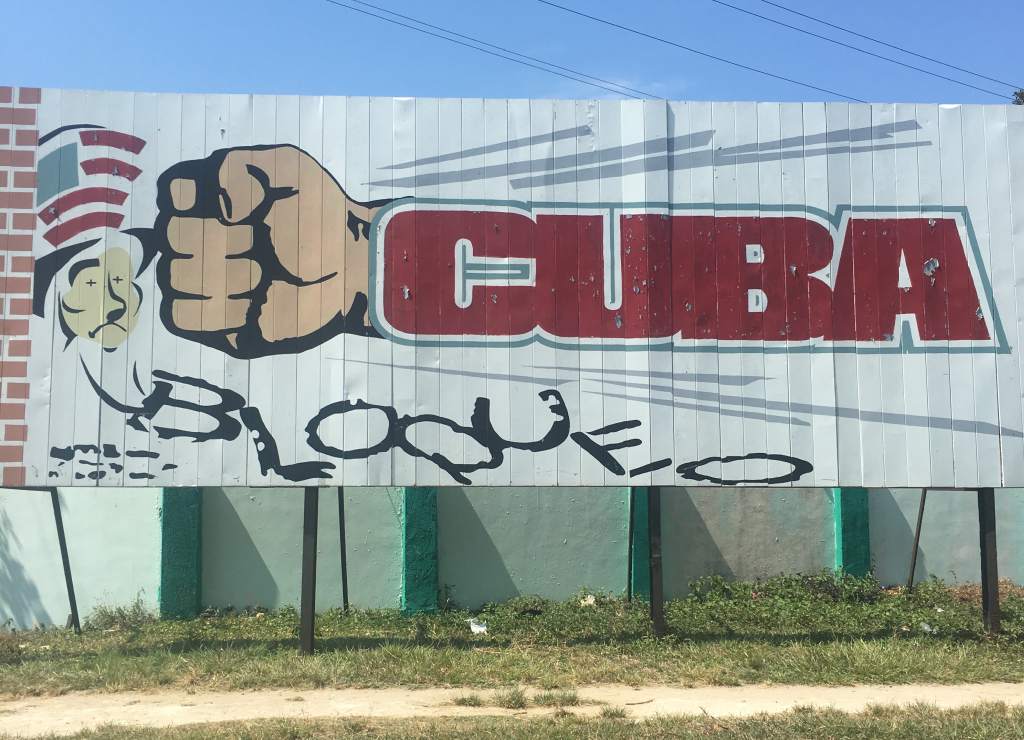
Graffiti from Cuba (cropped), July 2015, unknown author (bloqueo = blockade). Photo by Yoav Litvin (Wikimedia Commons)
It looks like contacts with artists and their work substantially widened your horizons — that you discovered the arts as an important, worthwhile, and satisfying form of creativity. How did that unfold?
Yes. The arts have been a genuinely transformative discovery. Working on my book Outdoor Gallery — NYC, I came to work with 46 artists simultaneously. Each a unique talent, with incredibly diverse background, and different stories, though all looking to express themselves in the streets and connect to community. Some looking to extend their works into galleries in New York and the world, others to keep their art pure, uncommodified and independent. As I explore in my second book 2Create, the arts are a form of connection. Each collaboration taught me something else about ways to connect, to collaborate and thereby to grow. One plus one is truly more than two. Collaborations can replace the rewards of aggression with the rewards of healthy human connection. They reflect communities and individuals, their conflicts and their joys, and can function without the filters of commercial interest. I find that deeply compelling and inspiring as we look for alternative means to heal and grow.
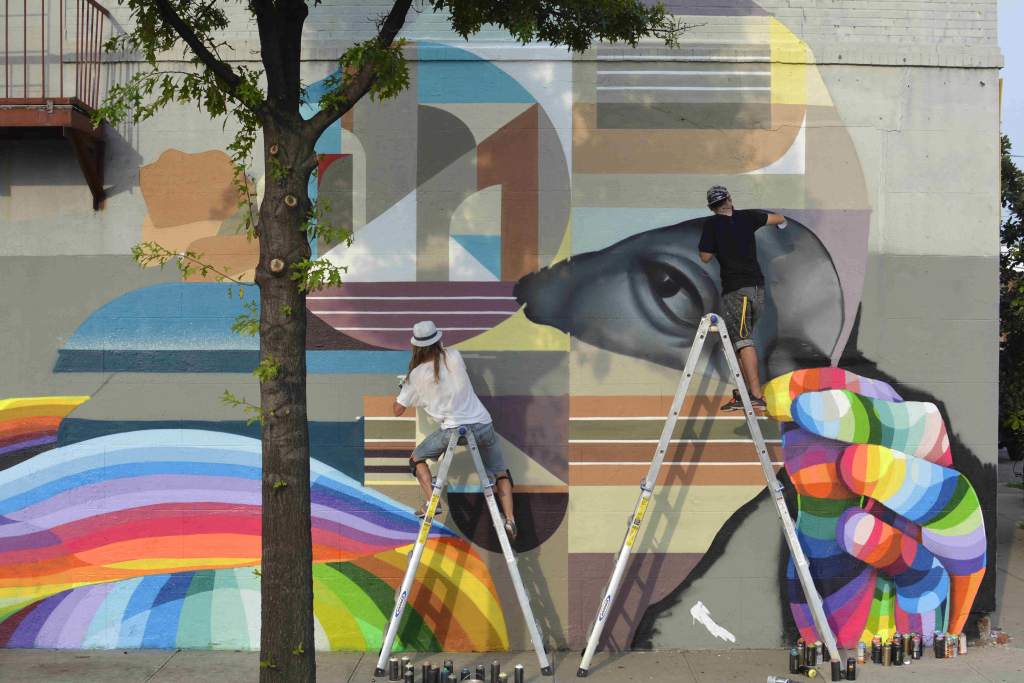
Street artist duo Dasic Fernandez and Rubin415 working on a large mural in New York, July 2015, photo by Yoav Litvin
9/11 shattered not only the US — the new millennium clearly brought an end to the relative calm of the post-WWII era. How and when did you discover that writing about politics could be your vocation?
As I spent more and more time outside my basic vocation, science and academia, and became increasingly involved in the arts and politics, it became clear to me that these paths were mutually exclusive. Academia required sole focus on science, and I was no longer willing to accept that constraint. I also knew I could not remain competitive against those who devote themselves entirely to academic work, and that academia would limit my freedom of political expression. In 2014 I left my position at The Rockefeller University and became a freelance writer in the sciences, working with various medical and science companies. From 2012 I had been engaged in art photography, and from 2015 I also began publishing in the field of political analysis, in the US and abroad.
That year, I first applied my scientific training to political analysis. I reached out to the late Uri Avnery, longtime Israeli peace activist and politician, and shared my observations. He responded enthusiastically.
See his impression here: https://www.counterpunch.org/2015/09/25/netanyahus-ministry-of-fear/
He encouraged me to publish, and I did: https://www.counterpunch.org/2015/09/28/fear-trauma-and-healing-a-scientific-analysis-of-the-israeli-palestinian-relationship/
From there I gradually developed a comprehensive behavioral model of colonial aggression, now fully presented in Wired to Steal, co-authored with Ilan Pappé. The collaboration with Professor Pappé has been a rich and wonderful experience.
It has been a journey of personal discovery: from a sheltered boy raised in Jerusalem on a diet of Zionist mythology, largely unaware of the world beyond it, through science, music, art and politics, and through the harder work of confronting my own privilege, accountability, guilt and shame, toward a clearer picture of the forces that guide society and of how ordinary people are conscripted into serving them. It has also led me to understand what co-resistance and solidarity actually mean, not as slogans, but as practice.
When did you move from New York to Bellingham? Was it a difficult decision to leave the city?
I truly enjoyed my time in New York. I lived in Manhattan for six years, immersed in the arts and music scenes, and published two books about the city. But NYC works best when you have at least two of three things: youth, money, or being single. Once you're down to one, or none, it's time to leave. Better to go willingly than with your tail between your legs.
I left right after my exhibition and book launch of 2Create: Art Collaborations in New York City (Schiffer Books, 2016) at the Bronx Museum; an exhibit called 2Gether: Portraits of Duos in Harlem and the Bronx, with my friend and colleague Tau Battice, a photographer and lecturer at CUNY. Born in St. Kitts-Nevis and based in Harlem, Tau gave me an extraordinary window into the rich, diverse peoples and cultures of Harlem and the Bronx. We presented portraits from our unique vantage points — Tau as an insider and myself as an outsider. Hence I chose the wide angle lens for all my photographs in this exhibit.
See here: https://www.jadaliyya.com/Details/40666
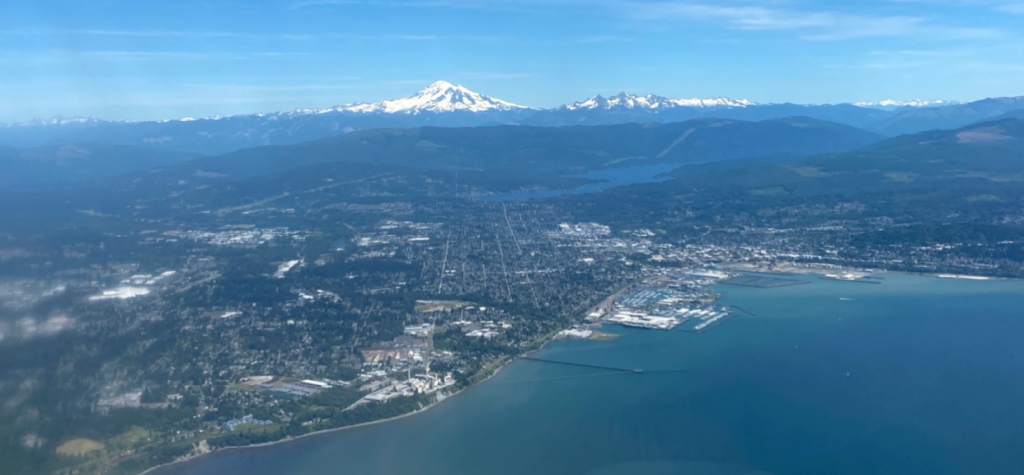
City of Bellingham with Glacier Peak, 2.285 m on the horizon (cropped), June 2021. Photo by Fernando Gonzalez (Wikimedia Commons)
What about matters of the heart?
I am happily married with two children, a son and a daughter. We live in Bellingham, WA.
Travelling is always interesting. Is there any place you've visited that you'd gladly return to?
Any place with a quiet beach. I love beaches. I’d love to visit Japan, and Africa, particularly its north — Egypt, Morocco and Algeria. Or go down south and visit a safari. I’ev heard great things about Kruger National Park in South Africa. I’d love to live in Europe for an extended period, preferably on the Mediterranean.
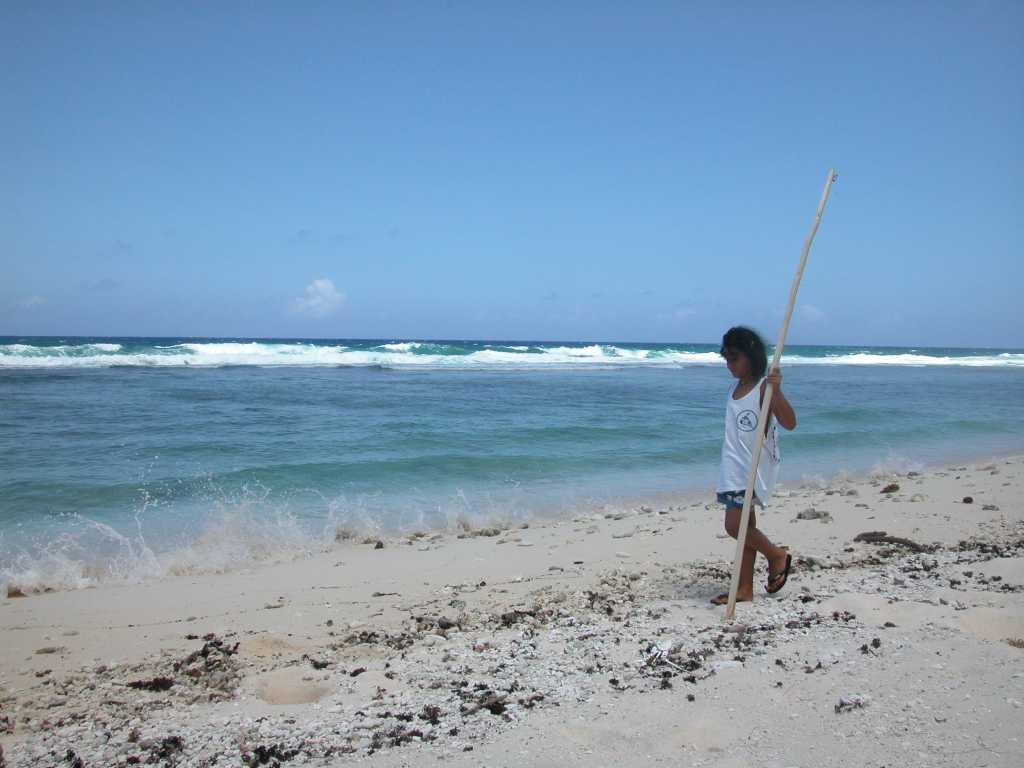
The beach with Maimiti, at Peva Iti, Rurutu, Austral Islands, February 2003, photo by the author
Have you ever had any experience with some cave, in Israel or elsewhere?
Yes, but only as an amateur. There is a cave in Israel I've done but you must forgive me as I cannot elaborate on that — it was many years ago. I am somewhat claustrophobic.
The cave you visited was probably Soreq or Stalactite Cave, 30 km west of Jerusalem, the most known Israeli cave.
Yes, I believe you are right. It must have been the Soreq Cave.
_PC_by_PJ_1024x683px.jpg)
A scene in the hall of Soreq Cave, renamed Avshalom Cave in 1977, photo by Omer Markovski, 2016 (Wikimedia Commons). It's perspective was corrected by the author.
To wrap things up — a few lighter questions. What kind of music do you like best?
Jazz, Indian classical music, African music, classic rock, some electronic music, Brazilian music, flamenco, Arabic music and some classical music as well.
What would you pick as your favorite movies?
All About My Mother, The Shawshank Redemption, The Wire (TV series), The Battle of Algiers, All That's Left of You, Wild Style. There are many more. So many wonderful film makers out there.
I myself wrote a movie and a TV series, though these were not produced, unfortunately. The TV series is based on true events about the Black Panther Party in 1968, specifically its base in Seattle and the Pacific Northwest. The movie is historical fiction titled "Odessa":
During a turbulent visit to Odessa in modern day Ukraine, Tsars Alexander II and Alexander III of Russia find themselves hunted by assassins and haunted by the promise of a magical fish whose power to heal social divisions may offer one final chance to save their empire.
Is there a book you like the most?
The Stranger by Albert Camus, Frederick by Leo Lionni, Of Mice and Men by John Steinbeck, The Old Man and the Sea by Ernest Hemingway, The God of Small Things by Arundhati Roy. Outdoor Gallery - New York City, of course, by Yoav Litvin.
All dishes can be delicious. But surely there's one you like in particular?
I’m a tomato freak, a recovering chocolate addict, a current coffee addict, lover of wine and devourer of knafeh.
What would be your favorite color, and why?
Green. Because it is life. I live in the forest and enjoy hundreds of shades of green daily. It calms my body and soul.
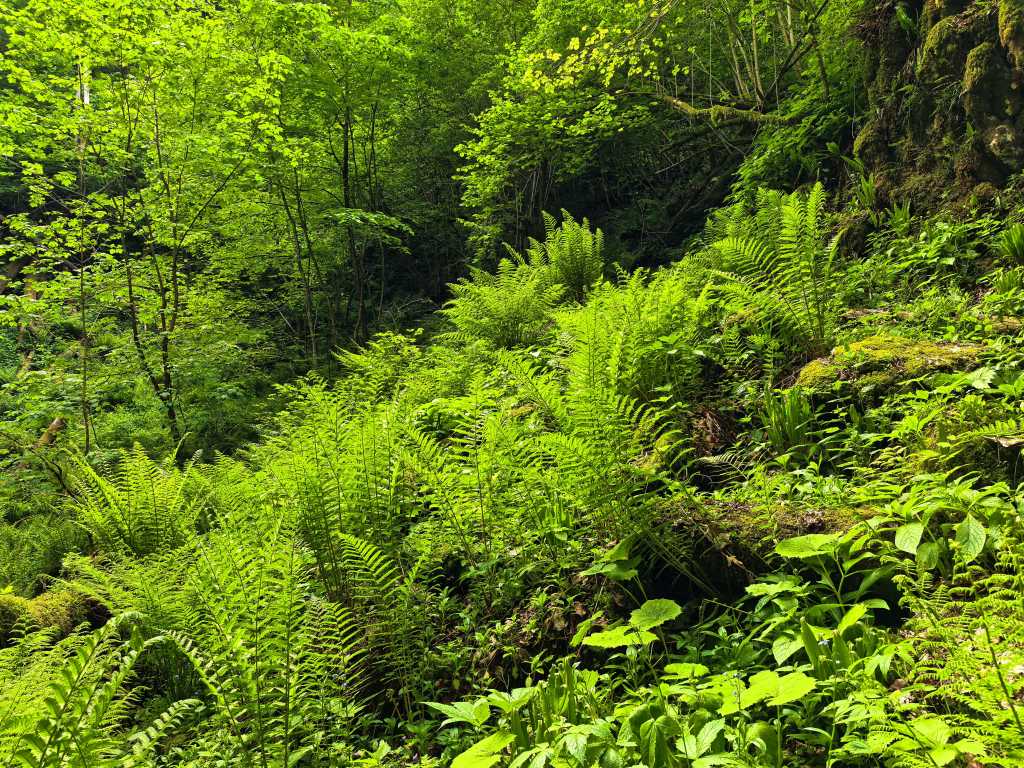
Ferns and hazels in front of the North entrance to the cave Skednena jama, May 2026, photo by the author
Related posts:
 Mitja Mršek and Mt. Rombon Cave System, March 2026

This page and its text by Primož Jakopin. The title photo
is by Ravi Sadu (Wikimedia Commons). Other photographers are credited next to their photos or in the
accompanying text; all photos are either open access (Wikimedia Commons) or published with their permission.
Send inquiries and comments to primoz jakopin guest arnes si (insert dots and at sign as appropriate).
The page was initiated in January 2026.
Last correction: June 15, 2026.
URL: http://www.jakopin.net/portraits/Yoav_Litvin/YL_index.php
907